



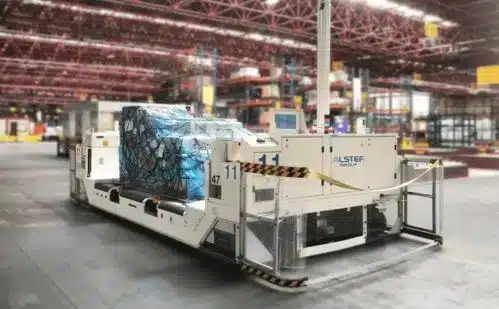
The Shift Towards Flexible Air Cargo Operations
AGVs are becoming much more common in air cargo operations, but the reasons behind that shift are fairly straightforward. It’s not about chasing new technology or making terminals look more automated. It’s about solving a few persistent challenges that operators have been dealing with for years.
Safety is one of the main drivers. Cargo terminals are busy environments, with people, vehicles and equipment all moving at once, often under time pressure. Manual transport works, but it relies heavily on coordination and judgement in the moment. AGVs introduce a more controlled way of moving ULDs through the terminal. Routes are defined, speeds are consistent, and interactions between people and equipment become more predictable. It doesn’t remove the human element, but it does reduce the level of risk in day-to-day operations.
Labour is another factor that’s hard to ignore. Moving ULDs is a necessary part of the operation, but it’s repetitive and requires coverage across multiple shifts. It’s also one of the roles that can become difficult to resource consistently. AGVs reduce the reliance on manual driving tasks, which brings more stability to the operation and allows teams to focus on areas where human input adds more value. In the current environment, where labour availability is a real constraint, that shift is becoming increasingly important.
Flexibility is often less obvious, but just as important. Many traditional transport systems are built around fixed infrastructure, which works well until something changes. In air cargo, things change frequently. Volumes fluctuate, processes evolve, and layouts need to adapt over time. AGVs are not tied to a single physical path in the same way, which makes it easier to adjust flows, scale capacity, or reconfigure parts of the operation without major disruption. That ability to adapt is a significant advantage in a dynamic environment.
What stands out is that the move towards AGVs is being driven by operational needs rather than technology trends. Safety, labour and flexibility have always been pressure points in air cargo, and AGVs happen to address all three in a practical way. That’s why they’re becoming a more standard part of how modern cargo terminals operate.